
The situation involving the United States and Venezuela has roots that go back many years, and to understand why the U.S. reportedly carried out a military action or strong intervention against Venezuela, it’s important to look at a mix of political, economic, humanitarian, and geopolitical factors. It’s not a single reason, but a convergence of long-standing tensions.
Tensions between the U.S. and Venezuela have been high for decades, but they intensified in the early 2000s when Venezuela began to shift politically under leaders like Hugo Chávez and his successor, Nicolás Maduro. Chávez’s government pursued leftist policies, strengthened alliances with nations seen as adversarial to U.S. interests, and nationalized key industries including oil.
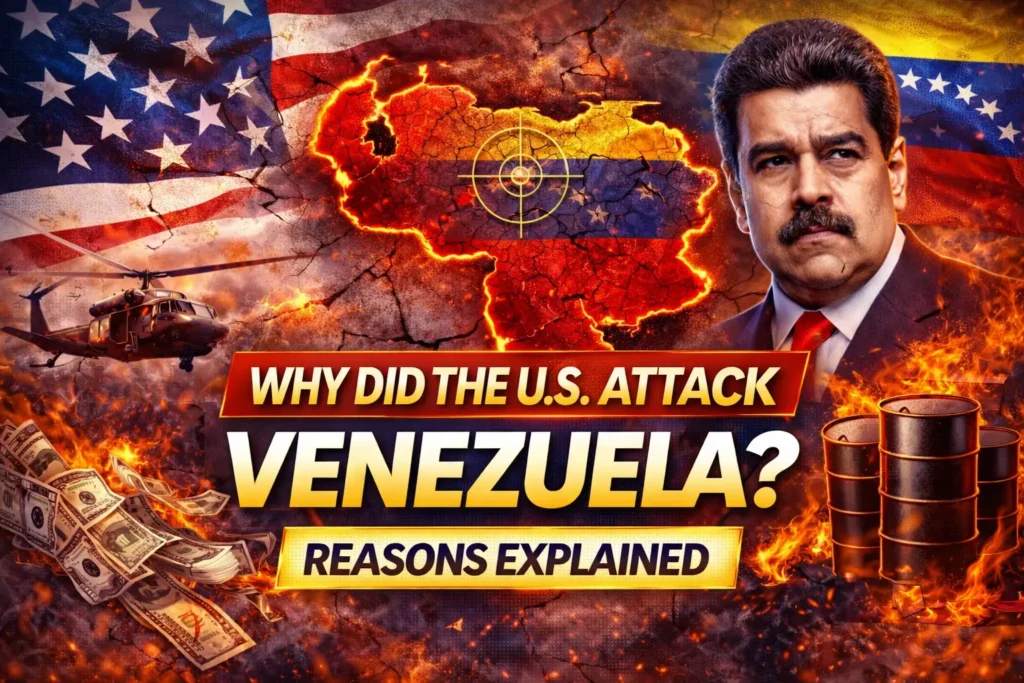
Venezuela’s oil reserves are among the largest in the world, and energy has long been a critical aspect of global power dynamics. When a country with massive energy resources is at odds with global superpowers, friction often escalates.
The U.S. has repeatedly criticized Venezuelan leadership for alleged failures of democracy, violations of human rights, and restrictions on political opposition. Sanctions were imposed, first on individuals and government officials and later more broadly on Venezuela’s economy, particularly its oil sector. These sanctions were meant to pressure the government to restore democratic norms and improve the humanitarian situation, but over time they also contributed to economic hardship for many Venezuelans.
As the humanitarian crisis deepened — marked by hyperinflation, food and medicine shortages, mass migration, and social instability — the rhetoric around possible intervention grew louder in some U.S. political circles. Policymakers and commentators in the U.S. framed possible intervention as a matter of both national security and moral responsibility to protect vulnerable populations. Critics of the Venezuelan government, including some Venezuelan opposition figures who were exiled or operating outside the country, sought international support to remove Maduro from power.
Against this backdrop, any reported military action, such as the alleged strike or capture of Maduro, reflects a dramatic culmination of mounting pressure and frustration within international diplomacy. American officials publicly justified stronger action by citing national security concerns, the need to combat alleged drug trafficking and organized crime networks linked to Venezuelan leadership, and the collapse of democratic institutions. However, even within the U.S., such justifications are debated. Some observers view aggressive actions as necessary to break a cycle of repression and to open the door for political transition, while others warn that military intervention undermines sovereignty and creates long-term instability.
Oil and economic interests cannot be dismissed when analyzing U.S. motivations. Venezuela’s vast oil reserves have been a strategic consideration in global energy markets. Control over energy resources has historically influenced foreign policy decisions by major powers, and while most official statements focus on democracy and stability, underlying economic interests often play an unspoken role in shaping priorities and responses.
Another factor is the broader geopolitical landscape. Venezuela’s alliances with countries that the U.S. views as rivals — including Russia, China, and Iran — heightened American concerns about influence in the Western Hemisphere. The Cold War may have ended decades ago, but geopolitics remains a game of influence and strategic positioning. In this context, a forceful action could be seen as an attempt to counter perceived encroachment by global adversaries and reassert influence over a region traditionally considered within the U.S.’s sphere.
At the same time, there are significant risks associated with military intervention. History offers many examples where foreign military involvement intended to restore stability instead prolonged conflict, created power vacuums, or worsened humanitarian conditions. Analysts warn that even if a government is widely criticized for human rights abuses, external intervention can lead to civil unrest, insurgencies, and regional destabilization, affecting neighboring countries and global markets.
In the specific case of Venezuela, public statements following the alleged U.S. action indicated mixed international reactions. Some countries and leaders condemned the move as a violation of sovereignty and international law, while others welcomed it as a potential step toward ending authoritarian rule. Human rights organizations and legal scholars expressed concern that military actions circumvent diplomatic processes, potentially setting precedents that could be misused elsewhere.
It is also important to recognize the role of misinformation and competing narratives. In highly polarized environments, claims about military activity, arrests of political leaders, or U.S. intentions can be exaggerated, misrepresented, or used for propaganda. Careful verification from multiple reliable sources — including official government statements, reputable news outlets, and international organizations — is essential to separate confirmed facts from speculation.
Ultimately, understanding why the U.S. attacked or intervened in Venezuela requires looking at a web of motivations: geopolitical strategy, energy interests, political ideology, humanitarian concerns, and long-standing diplomatic tensions. The situation is fluid and evolving, and what may seem like a military decision in one moment is often the product of decades of policy decisions, regional dynamics, and shifting global power balances.
In such complex international matters, there is rarely a single cause — instead, there is a convergence of pressures, interests, and historical context that shapes the decisions of nations.